

Earth's
Twin Sister
Project AETHER is humanity's return to the clouds — a long-duration aerostat probe for the habitable zone of Venus, where Earth-like pressure and temperate skies open a second world to science.
01 // The Objective
Cloudseeker: A Floating Laboratory
At roughly 50–55 km altitude, Venus has near–1 bar pressure and temperate temperatures — a scientifically interesting cloud environment. That fact is well established (VEGA balloons in 1985; ongoing NASA/ESA aerobot studies). The hard part is engineering a long-duration private mission that survives entry, acid, and float ops.
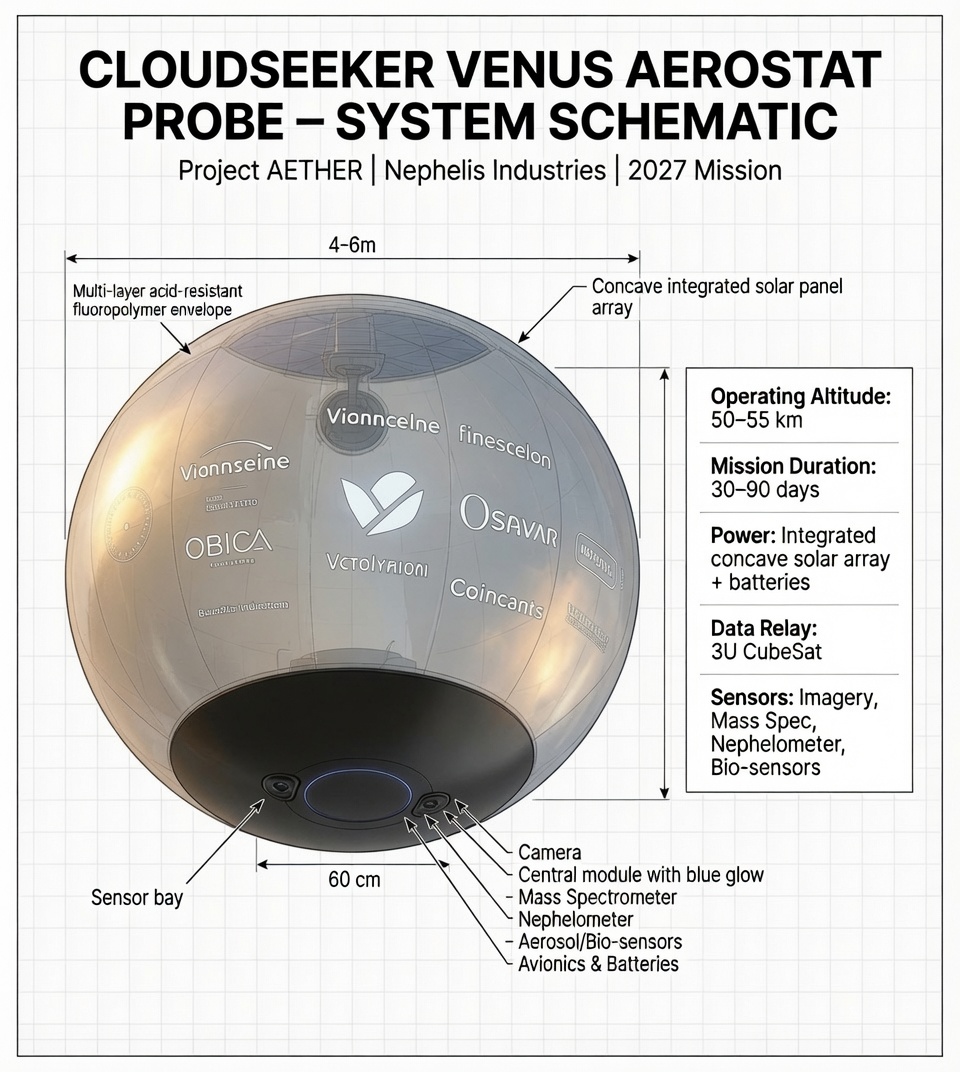
Project AETHER (Cloudseeker) is a concept for a super-pressure fluoropolymer aerostat and optional CubeSat relay. Today the program is in pre-hardware: public documentation, mass and risk models, and AETHER OS for open contribution — not a flight-ready stack.
Near-term execution (real work): acid-resistant material coupons, a small helium ground float with basic sensors/telemetry, and transparent logs of failures and tests. Flight architecture (entry system, inflation, rad-tolerant avionics, relay) remains trade/TBD until ground gates pass.
Vision (clearly labeled): long-term interest in cloud-layer science and habitation technology. A 30–90 day robotic probe is not “humanity’s backup plan” or a cloud city — it is, at most, an early science and engineering step. We keep the inspiration; we do not sell it as current maturity.
A ~$500k crowdfund target supports a ground demonstrator / early R&D campaign. A full Venus flight system will cost far more. Rideshare “$80/kg” figures on this site are illustrative architecture math, not booked launch contracts.
Contributors welcome (L1–L3) via GitHub and the volunteer form.
02 // Mission Control
Astrodynamics & Trajectory
Interactive trajectory sandbox (illustrative). Not a booked launch. Default epoch is a study date — adjust freely. Wet mass concept ~400 kg class; dry mass tunable in the tool.
Launch Phase
Delta-V Budget
TRK: HOHMANN
V_INF: 2.7 km/s
960,000 km
38M km
MAY 2031
Optimistic mass / cost sketch — not a contract
Concept wet mass ~400 kg for discussion of rideshare-class vehicles. Figures like $80/kg → ~$32k are hypothetical optimistic pricing, not a reserved Starship or Falcon secondary. Real Venus entry + float hardware will dominate cost long before launch services.
• Stowed fluoropolymer super-pressure balloon + inflation system: ~40 kg
• Gondola + integrated sensor suite (imagery, mass spec, nephelometer, bio-sensors): ~50 kg
• Avionics, power, structure, comms: ~30 kg
For ~120 kg floating mass at 55 km (ρ_net lift ≈ 0.8 kg/m³), only ~150 m³ volume is required → spherical diameter ~6.6 m. Extremely stowable, lower material mass, faster inflation, and easier packaging. Still delivers the full 30–90 day float with excellent margin.
Power/Comms/Thermal: Solar on balloon top + efficient systems. Radiation-hardened avionics. Site comms/day estimator and atmosphere model apply directly.
Optimistic rideshare math (e.g. $80/kg × 400 kg ≈ $32k) is a study figure, not a quote. Entry systems, materials, test campaigns, and avionics dominate real budgets. The public ~$500k target is for ground demonstrators and early R&D, not an end-to-end Venus flight.
03 // The Thesis
Why We Choose The Clouds
Venus is a compelling science target and a long-horizon industrial idea. Near-term we build and test; multi-planetary infrastructure remains vision, not current scope.
The Twin Paradox
When we say "Twin Sister," we aren't being poetic. We are talking about the critical physical constants required for human physiology and long-term habitation.
Gravity is the key. Living on Mars (0.38g) causes significant bone density loss and visual impairment. Venus offers 0.904g—nearly identical to Earth. It is the only place in the solar system where your body works the way it evolved to.
Atmospheric Shielding. The thick atmosphere (even at altitude) protects inhabitants from cosmic radiation that sterilizes the surface of Mars. In the clouds of Venus, you are shielded.
| Metric | Venus (55km) | Mars (Surface) | Earth (Surface) |
|---|---|---|---|
| Pressure | ~0.6 - 1.0 bar | 0.006 bar | 1.0 bar |
| Temperature | 27 - 50 °C | -63 °C (Avg) | 15 °C |
| Solar Flux | 2600 W/m² | 590 W/m² | 1360 W/m² |
| Radiation | Atmospheric Shielding | Unshielded | Shielded |
Habitation
At 50km, humans can live in breathable air habitats (21% O2, 79% N2) which act as lifting gas in the dense CO2 atmosphere. No pressurized suits required inside the habitat.
Resources (ISRU)
The atmosphere is a chemical factory. We can extract Oxygen and Carbon from CO2, Sulfuric Acid for industrial processes, and Nitrogen for agriculture.
Astrobiology
The cloud layer may host microbial life. Phosphine detection remains controversial but compelling. Cloudseeker carries sensors tuned to detect biological precursors.
Why Venus vs Mars
Venus complements Mars. At 50-55 km it offers near-Earth gravity (0.9g), pressure, and solar flux—superior for long-term human and AI thriving.
- Faster travel (future 30-45 days)
- Abundant atmospheric resources
- Better solar energy potential despite clouds
96.5% CO₂ (fuel/plastics), 3.5% N₂ (air), SO₂ & H₂SO₄ (chemical feedstocks). Solar: 1.91× Earth’s at top of atmosphere — massive potential for floating solar arrays and AI data centers. Chemical Feedstocks enable in-situ manufacturing far easier than Mars thin atmosphere.
Challenges (acid mitigation via altitude/materials) are solvable. Venus floating cities + Mars surface ops = true multi-planetary redundancy.
Cloudseeker Technology
Cloudseeker uses miniaturized, robust tech built for Venus extremes—paving the way for future life-sustaining outposts.
Acid-Resistant Aerostat
Multi-layered fluoropolymer balloon resists sulfuric acid; maintains stable float in the habitable zone—foundation for human/AI habitats.
Integrated Sensor Suite
Compact 1kg pod with 4K imagery, mass spectrometer, nephelometer, and bio-sensors (targeting ammonia/phosphine) to detect resources and potential life signs.
3U CubeSat Relay
Venus orbit relay for high-bandwidth data transmission—critical for future colony communications.
AI-Optimized Navigation
xAI models enable autonomous operations in Venus’s dynamic atmosphere—key for human-AI symbiosis off-Earth.
We need hardware donations, software contributions, and testing facilities. Coders, fabricators, and testers—join the build.
05 // Mission Archive
Standing on the Shoulders of Giants
While government and private efforts advance Venus science, Project AETHER fills the unique niche of low-cost habitation validation. Comprehensive log of humanity's attempts to reach Venus.
05 // Simulations
Venus Visions

Current Milestones
Open project. Human + AI collaboration.
The entire stack (content, visuals, code, research, automation) lives here. Volunteers can edit data/MDX, contribute designs, or help run agent loops.
Agents can propose changes, generate content, and keep the todo list fresh.
Support the work
Early crowdfund tiers support ground demonstrators and R&D. DNA / sample concepts need legal clearance before any sale. Prefer to build? Contribute on GitHub.
Tiers support early ground / R&D work, not a full Venus flight budget. Checkout opens when payment rails are configured. Program status.
Balloon Engraving
Laser-etch your name onto the aerostat balloon of Cloudseeker.
Live count when Stripe is configured
DNA Capsule
Send a biological sample (hair/nail) in our inert time capsule. Let a part of you make it to Venus.